News



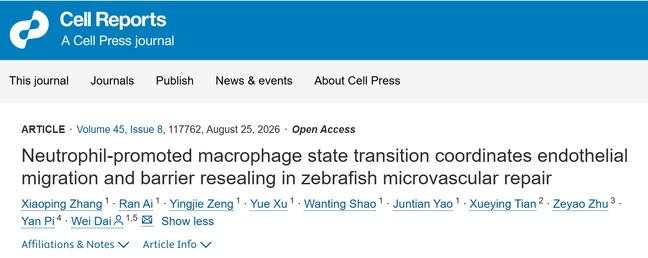
On July, 2026, the research group led by Associate Professor Wei Dai from the Institute of Metabolism and Integrative Biology (IMIB), Fudan University, published a research article entitled "Neutrophil-Promoted Macrophage State Transition Coordinates Endothelial Migration and Barrier Resealing in Zebrafish Microvascular Repair" in Cell Reports.
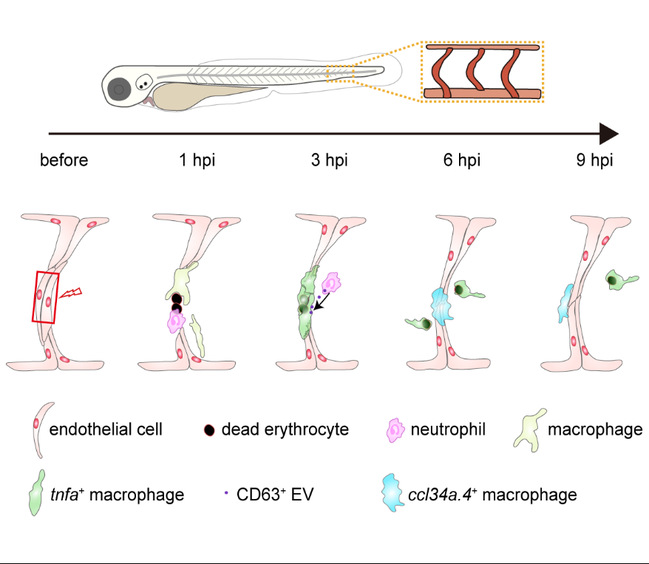
Microvessels are frequently damaged, yet the in vivo temporal logic that couples endothelial gap closure to barrier resealing, and the immune-cell interactions that coordinate these steps, remains poorly defined. Using live imaging of laser-injured zebrafish intersegmental vessels, we define a staged repair program: endothelial cells migrate to bridge the gap, trapped erythrocytes are cleared, and vascular permeability rises transiently before resealing. Neutrophils arrive first, whereas macrophages persist and undergo a neutrophil-dependent functional transition. Early tnfa-associated macrophages promote endothelial migration and erythrocyte debris removal, while later ccl34a.4+ pro-remodeling macrophages support barrier restoration. Neutrophil ablation delays this transition and selectively prolongs permeability defects. Neutrophils release CD63+ extracellular vesicles that are taken up by macrophages, and inhibiting EV/exosome secretion phenocopies key features of neutrophil loss. These findings provide a temporal framework to dissect immune-endothelial coordination during microvascular repair.
Link: https://www.cell.com/cell-reports/fulltext/S2211-1247(26)00840-5
复旦大学 代谢与整合生物学研究院 版权所有
Copyright@2018fudan.edu.cn All rights reserved.
上海市杨浦区淞沪路2005号。邮编:200438。电话:021-31242078,021-31242079
 Fudan Email
 Fudan Ehall