News



On August 12, 2026, the research group led by Terytty Yang Li from the Institute of Metabolism and Integrative Biology, Fudan University, in collaboration with Johan Auwerx, Liangshan Mu and others, published a research paper entitled “Mitochondrial stress activates ELT-2-dependent lysosomal proteostasis to extend lifespan in C. elegans” in Science Advances.
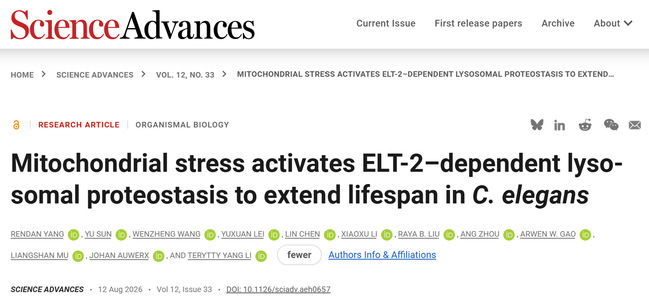
Mild mitochondrial stress could extend lifespan across species, yet the underlying mechanism remains unclear. Here, we show that inhibition of mitochondrial respiration induces a sustained transcriptional program that enhances lysosomal proteolysis during aging in Caenorhabditis elegans. Mechanistically, this response is primarily regulated by the intestinal GATA transcription factor ELT-2, which retains high expression and directly binds to GATA motifs in the promoters of lysosomal protease genes to promote their transcriptional activation. Moreover, we identified R249 within the conserved zinc-finger DNA binding domain of ELT-2 as a key residue required for its transcriptional activity. Notably, this mitochondrion–ELT-2–lysosome axis operates largely independently of the mitochondrial unfolded protein response (UPRmt) to counteract aging. Furthermore, increased lysosomal activity, as well as the lysosomal proteases CPR-5 and CPR-8, is essential for mitochondrial stress–induced clearance of toxic polyglutamine (polyQ) aggregates and lifespan extension. Together, our findings reveal a previously unrecognized ELT-2–dependent lysosomal proteostasis pathway that acts downstream of mitochondrial stress to maintain protein homeostasis and promote longevity.
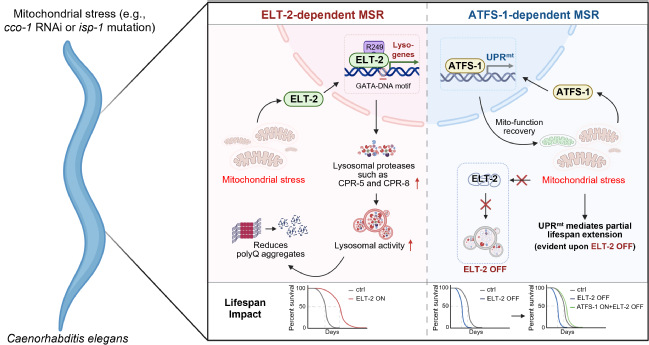
Fig. A model depicts the role of ELT-2– and ATFS-1–mediated mitochondria stress response in orchestrating lysosomal and mitochondrial homeostasis, coordinating cellular proteostasis and organismal longevity.
Link: https://doi.org/10.1126/sciadv.aeh0657
复旦大学 代谢与整合生物学研究院 版权所有
Copyright@2018fudan.edu.cn All rights reserved.
上海市杨浦区淞沪路2005号。邮编:200438。电话:021-31242078,021-31242079
 Fudan Email
 Fudan Ehall