News



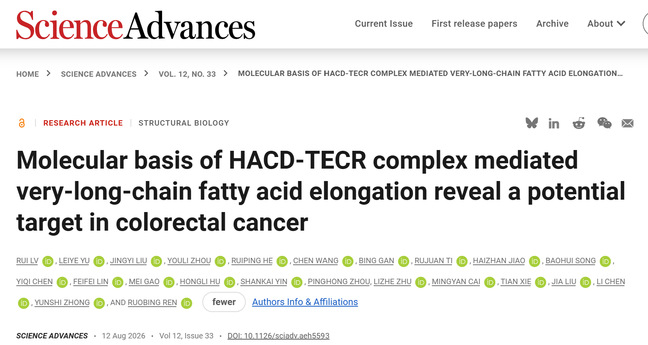
On August 13, 2026, the research group led by Young Investigator Ruobing Ren from the Institute of Metabolism and Integrative Biology, Fudan University, in collaboration with the teams of Yunshi Zhong from Zhongshan Hospital, Fudan University, Li Chen from the Institute of Metabolism and Integrative Biology, Fudan University, Jia Liu from the Shanghai Institute of Materia Medica, Chinese Academy of Sciences, and Tian Xie from Soochow University, published a research paper entitled “Molecular basis of HACD‑TECR complex mediated very‑long‑chain fatty acid elongation reveal a potential target in colorectal cancer” in Science Advances.
Remodeling of fatty acid metabolism is increasingly recognized as a critical feature of tumor progression, yet the contribution of very long-chain fatty acid (VLCFA) remains incompletely understood. The elongation of VLCFAs, which is mediated by four consecutive enzymes in the endoplasmic reticulum (ER), has been implicated in tumor progression. However, the molecular mechanisms underlying VLCFA elongation enzymes and their specific contributions to tumorigenesis remain largely elusive. Here, we demonstrate that trans-2-enoyl-CoA reductase (TECR) is upregulated in colorectal cancer (CRC). Structural and biochemical analyses revealed a conserved catalytic mechanism for TECR-mediated trans-2-enoyl-CoA reduction. Moreover, we show that TECR forms a stable complex with 3-hydroxyacyl-CoA dehydratase (HACD), to cooperatively drive VLCFA elongation. A unique U-shaped loop in HACD is critical for recognizing TECR. Disruption of the HACD–TECR interaction interface significantly suppresses CRC cell growth. Collectively, these findings elucidate the molecular mechanism of HACD–TECR-mediated VLCFA elongation and suggest a potential therapeutic strategy for CRC treatment by modulating VLCFA metabolism.
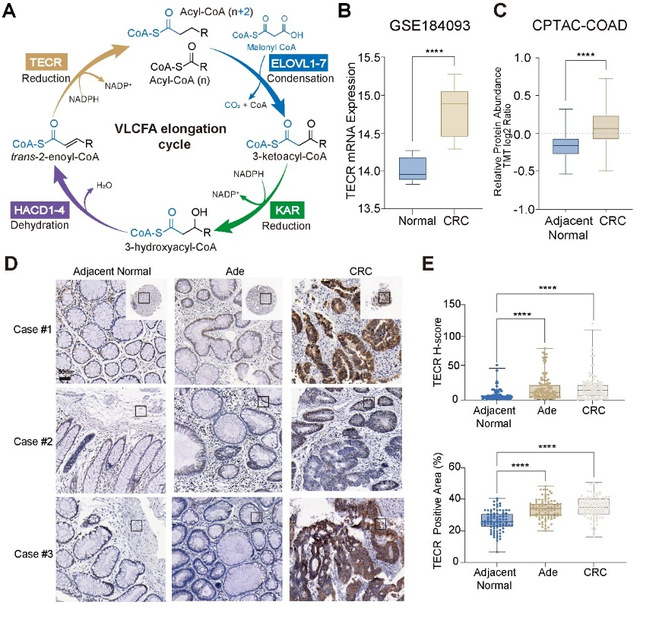
Fig. 1. TECR is associated with CRC cell proliferation and tumorigenesis.

复旦大学 代谢与整合生物学研究院 版权所有
Copyright@2018fudan.edu.cn All rights reserved.
上海市杨浦区淞沪路2005号。邮编:200438。电话:021-31242078,021-31242079
 Fudan Email
 Fudan Ehall