News



Recently, the research team led by Associate Professor Xingrong Du from the Institute of Metabolism and Integrative Biology, Fudan University, published a research article entitled “Amino acid homeostasis by CORVET/HOPS: A metabolic and stress resilience checkpoint for T cells” in PNAS.
Amino acid sufficiency is critical for T cell metabolic reprogramming, yet how T cells maintain amino acid homeostasis remains poorly defined. Here, we identify the CORVET and HOPS (CORVET/HOPS) tethering complexes as essential upstream regulators. In activated T cells, they sustain intracellular amino acid levels by promoting macropinocytosis to acquire extracellular nutrients. This function enables dual signaling outcomes: suppression of the integrated stress response (ISR) and activation of mTORC1, which together license metabolic plasticity and effector function. Genetic ablation of core subunits (VPS18 or VPS11) of CORVET/HOPS induces severe amino acid scarcity, triggers pathological ISR activation, and impairs mTORC1 signaling, leading to reduced peripheral T cell numbers and abrogating both inflammatory and protective immunity in vivo. These defects are mechanistically linked: BIM deletion or enforced mTORC1 activity rescues the survival and proliferative failures, respectively, of CORVET/HOPS-deficient T cells. Our work establishes CORVET/HOPS as fundamental couplers linking nutrient acquisition to immune signaling, revealing a targetable node for immuno-metabolic therapy.
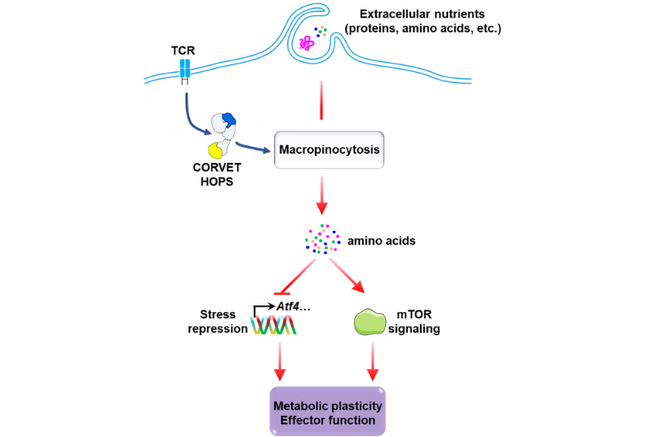
Fig. Schematic model of CORVET/HOPS complex-mediated regulation of T-cell metabolism and function
Link: https://www.pnas.org/doi/10.1073/pnas.2601318123
复旦大学 代谢与整合生物学研究院 版权所有
Copyright@2018fudan.edu.cn All rights reserved.
上海市杨浦区淞沪路2005号。邮编:200438。电话:021-31242078,021-31242079
 Fudan Email
 Fudan Ehall