News



On August 28, 2026, the research team led by Lingbo Wang from the Institute of Metabolism and Integrative Biology, Fudan University, published a research paper entitled “Donor-complementary prime editing enables precise kilobase and library-compatible DNA insertions” in Nature Biotechnology.
Methods for precise genomic DNA insertion that avoid double-strand breaks (DSBs) are constrained by limited throughput or the need for multistep editing. Here we report donor-complementary prime editing (DoPE), which combines a 3′-overhang double-stranded DNA (odsDNA) donor with a pair of overhang-complementary prime editing guide RNAs (opegRNAs) and a PE2* prime editor to achieve precise insertion of DNA sequences up to 12.5 kilobases (kb). Using one opegRNA pair and donor pools constructed from synthesized single-stranded oligonucleotides, we demonstrate in situ saturation mutagenesis across a targeted EGFP region at both amino acid and nucleotide resolutions. DoPE employing short (approximately 30-nucleotide) overhangs supports various insertions ranging from small fragments to those exceeding 10 kb. Furthermore, we replace mutant exons of PRKCSH, either individually or simultaneously, to correct diverse mutations, establishing a mutation-agnostic approach that corrects distinct alleles uniformly in vitro. Our study demonstrates DoPE as a one-step, DSB-free and library-compatible method for precise insertion of large DNA fragments without requiring recombinases or transposases.
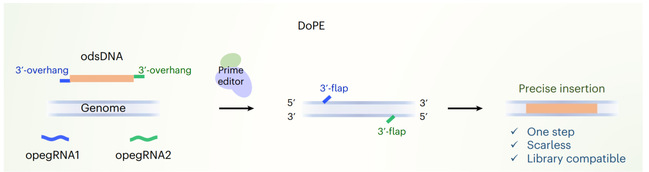
Fig. Schematic diagram for the working principle of DoPE.
Link: https://www.nature.com/articles/s41587-026-03296-w
复旦大学 代谢与整合生物学研究院 版权所有
Copyright@2018fudan.edu.cn All rights reserved.
上海市杨浦区淞沪路2005号。邮编:200438。电话:021-31242078,021-31242079
 Fudan Email
 Fudan Ehall