News



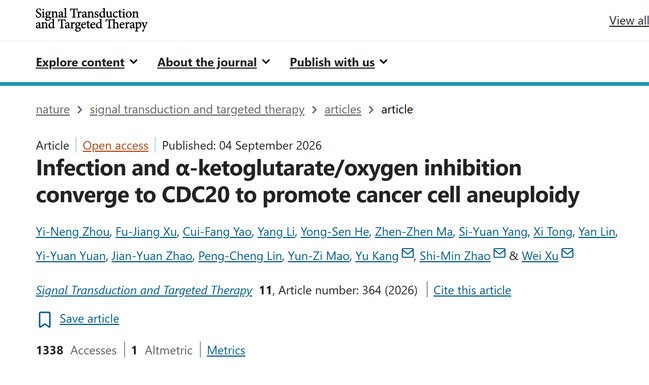
Recently, Professor Shimin Zhao and his collaborators from the Institute of Metabolism and Integrative Biology, Fudan University, published a study entitled “Infection and α-ketoglutarate/oxygen inhibition converge to CDC20 to promote cancer cell aneuploidy” in Signal Transduction and Targeted Therapy (IF: 81.2).
Aneuploidy is pervasive in cancers and contributes to chemoresistance; however, how aneuploidy-inducing stresses, such as infection and hypoxia, promote chemoresistance remains unclear. Here, we identify a prolyl hydroxylase domain protein 1 (PHD1)–E3 ubiquitin ligase TRIM21–cell division cycle protein 20 (CDC20) signaling axis that integrates infection- and PHD1-inhibitory signals to drive aneuploidy and chemoresistance. Analysis of clinical specimens revealed that HPV-positive cervical cancers exhibited reduced CDC20 expression and increased aneuploidy compared with HPV-negative tumors. Through proteomic screening, we found that CDC20 is targeted for degradation by TRIM21, which preferentially recognizes CDC20 when prolines 337 and 340 are non-hydroxylated. Hypoxia and α-ketoglutarate (α-KG) limitation impair the activity of the dioxygenase PHD1, thereby increasing the fraction of non-hydroxylated CDC20. In parallel, infection activates TRIM21. Thus, PHD1 inactivation and infection converge on CDC20 to reduce its abundance, leading to the accumulation of CDC20 substrates, including the separase inhibitor securin and the anti-apoptotic protein MCL1. Infection- and PHD1 inhibition-induced securin accumulation promotes aneuploidy, whereas MCL1 accumulation enhances chemoresistance. In cultured cancer cells and mouse xenograft models, stabilization of CDC20, either through TRIM21 inhibition or PHD1 activation, attenuates aneuploidy and restores chemosensitivity. Together, our study reveals a PHD1–TRIM21–CDC20 signaling axis that integrates hypoxic and infection-associated cues to regulate aneuploidy and chemoresistance, highlighting this pathway as a potential therapeutic target for overcoming chemoresistance.
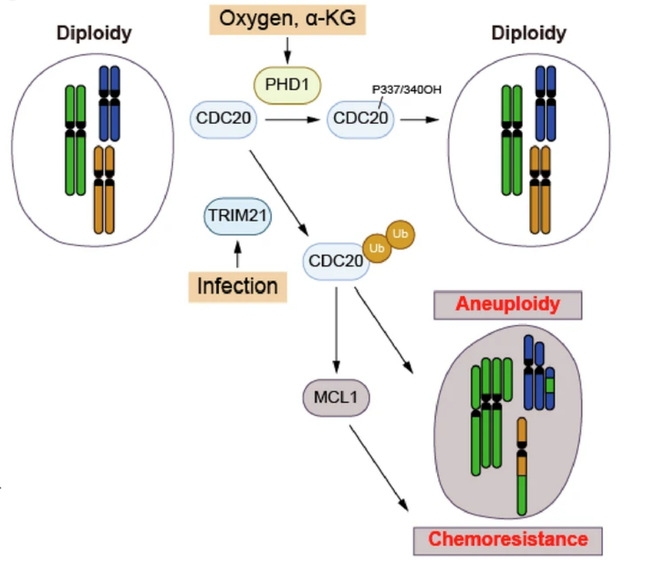
Fig. Schematic diagram of the mechanisms by which infection and hypoxia contribute to aneuploidy and chemotherapy resistance in cancer cells.
Link: https://doi.org/10.1038/s41392-026-02956-2
复旦大学 代谢与整合生物学研究院 版权所有
Copyright@2018fudan.edu.cn All rights reserved.
上海市杨浦区淞沪路2005号。邮编:200438。电话:021-31242078,021-31242079
 Fudan Email
 Fudan Ehall