News



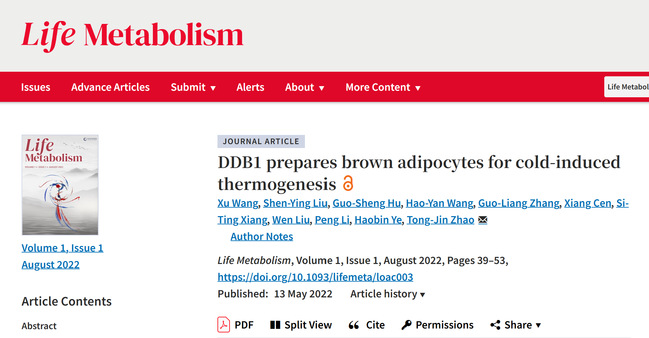
On May 13, 2022, Tongjin Zhao's research group from the Institute of Metabolism and Integrative Biology, Fudan University, published a research paper entitled "DDB1 Prepares Brown Adipocytes for Cold‑Induced Thermogenesis" in Life Metabolism.
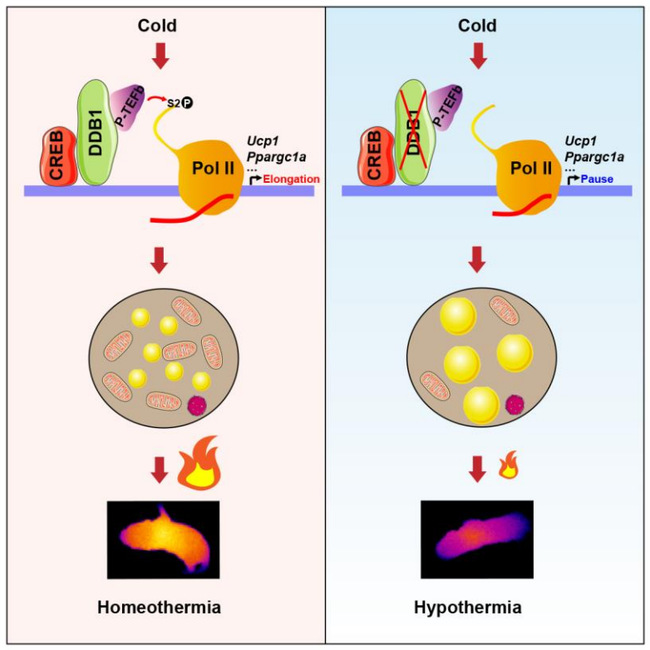
Brown adipose tissue (BAT) plays a key role in thermogenesis during acute cold exposure. However, it remains unclear how BAT is prepared to rapidly turn on thermogenic genes. Here, we show that damage-specific DNA binding protein 1 (DDB1) mediates the rapid transcription of thermogenic genes upon acute cold exposure. Adipose- or BAT-specific Ddb1 knockout mice show severely whitened BAT and significantly decreased expression of thermogenic genes. These mice develop hypothermia when subjected to acute cold exposure at 4 °C and partial lipodystrophy on a high-fat diet due to deficiency in fatty acid oxidation. Mechanistically, DDB1 binds the promoters of Ucp1 and Ppargc1a and recruits positive transcriptional elongation factor b (P-TEFb) to release promoter-proximally paused RNA polymerase II (Pol II), thereby enabling rapid and synchronized transcription of thermogenic genes upon acute cold exposure. Our findings have thus provided a regulatory mechanism of how BAT is prepared to respond to acute cold challenge.
Link: https://academic.oup.com/lifemeta/advance-article/doi/10.1093/lifemeta/loac003/6584503
复旦大学 代谢与整合生物学研究院 版权所有
Copyright@2018fudan.edu.cn All rights reserved.
上海市杨浦区淞沪路2005号。邮编:200438。电话:021-31242078,021-31242079
 Fudan Email
 Fudan Ehall