News


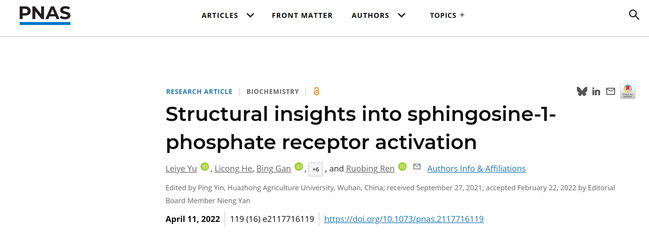
On April 11, 2022, Young Investigator Ruobing Ren from the Institute of Metabolism and Integrative Biology, Fudan University, Professor Sheng Wang from the Shanghai Institute of Biochemistry and Cell Biology, Chinese Academy of Sciences, and Assistant Professor Lizhe Zhu from the Chinese University of Hong Kong, Shenzhen, cooperated and published online their article entitled “Structural Insights into Sphingosine‑1‑phosphate Receptor Activation” in The Proceedings of the National Academy of Sciences.
Sphingosine-1-phosphate (S1P) receptors are valid therapeutic targets to treat autoimmune diseases, such as relapsing multiple sclerosis and ulcerative colitis. Particularly, S1PR1 is well characterized because of its nonredundant functions on T and B cells’ egress. However, the activation mechanism of S1PR1 is still poorly understood. Therefore, we determined active S1PR1–Gi complex structures bound to distinct agonists. Phosphorylated Fingolimod [(S)-FTY720-P] could modulate lymphocyte trafficking and treat multiple sclerosis. The nonlipid-like agonist CBP-307 is currently being evaluated in a global phase 2 clinical study in moderate to severe ulcerative colitis and Crohn’s disease. Meanwhile, two binding poses of CBP-307 and the unoccupied subpocket we observed may provide opportunities to improve further the efficacy and specificity of CBP-307 targeting different S1P receptors.
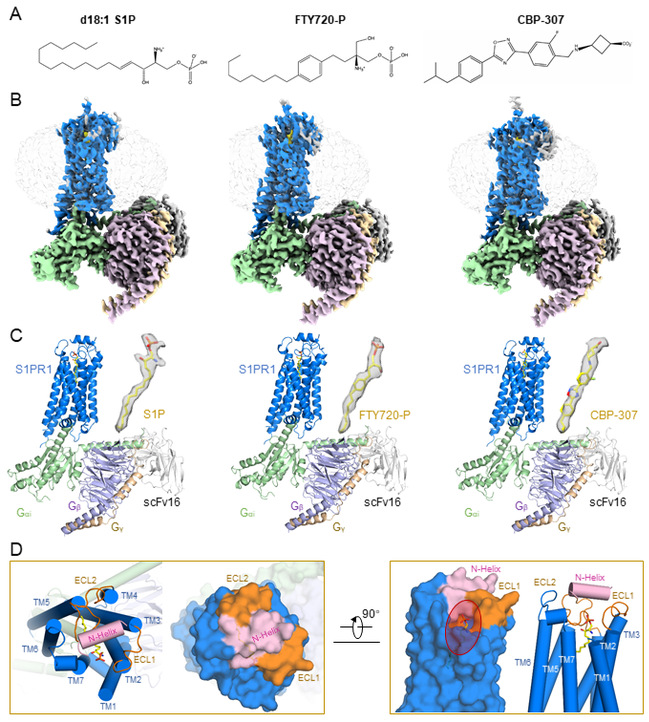
Fig. Cryo-EM maps and structures of human S1PR1 with Gi and agonist d18:1 S1P, (S)-FTY720-P, or CBP-307.
Link: https://www.pnas.org/doi/10.1073/pnas.2117716119
复旦大学 代谢与整合生物学研究院 版权所有
Copyright@2018fudan.edu.cn All rights reserved.
上海市杨浦区淞沪路2005号。邮编:200438。电话:021-31242078,021-31242079
 Fudan Email
 Fudan Ehall