News



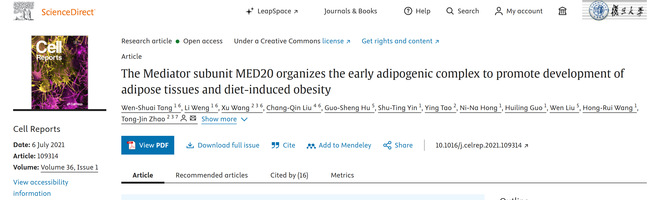
On July 6, 2021, the research group of Professor Tongjin Zhao at the Institute of Metabolism and Integrative Biology (IMIB), Fudan University, published a research paper entitled “The Mediator Subunit MED20 Organizes the Early Adipogenic Complex to Promote Development of Adipose Tissues and Diet‑induced Obesity” in Cell Reports.
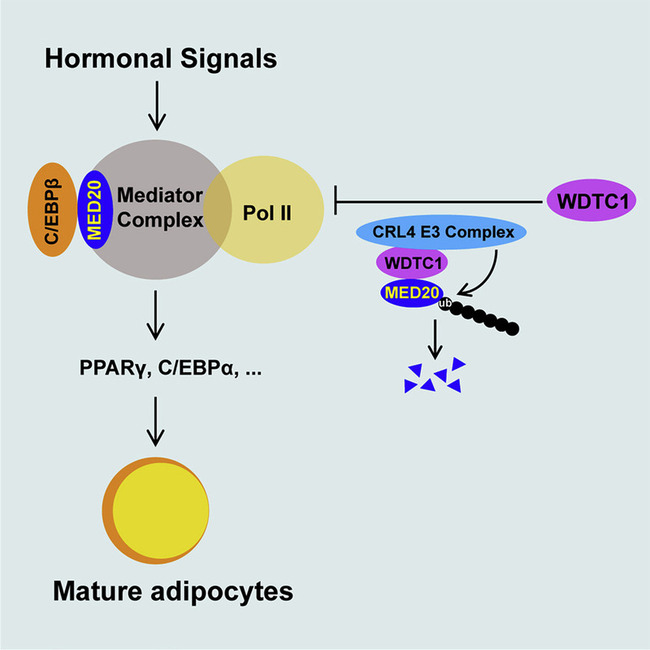
MED20 is a non-essential subunit of the transcriptional coactivator Mediator complex, but its physiological function remains largely unknown. Here, we identify MED20 as a substrate of the anti-obesity CRL4-WDTC1 E3 ubiquitin ligase complex through affinity purification and candidate screening. Overexpression of WDTC1 leads to degradation of MED20, whereas depletion of WDTC1 or CUL4A/B causes accumulation of MED20. Depleting MED20 inhibits adipogenesis, and a non-degradable MED20 mutant restores adipogenesis in WDTC1-overexpressing cells. Furthermore, knockout of Med20 in preadipocytes abolishes development of brown adipose tissues. Removing one allele of Med20 in preadipocytes protects mice from diet-induced obesity and reverses weight gain in Cul4a- or Cul4b-depleted mice. Chromatin immunoprecipitation sequencing (ChIP-seq) analysis reveals that MED20 organizes the early adipogenic complex by bridging C/EBPβ and RNA polymerase II to promote transcription of the central adipogenic factor, PPARγ. Our findings have thus uncovered a critical role of MED20 in promoting adipogenesis, development of adipose tissue and diet-induced obesity.
Link: https://doi.org/10.1016/j.celrep.2021.109314
复旦大学 代谢与整合生物学研究院 版权所有
Copyright@2018fudan.edu.cn All rights reserved.
上海市杨浦区淞沪路2005号。邮编:200438。电话:021-31242078,021-31242079
 Fudan Email
 Fudan Ehall