News



Recently, the research group of Professor Tongjin Zhao from the Institute of Metabolism and Integrative Biology, Fudan University, published a research article entitled “DHHC13 controls lysosomal cholesterol egress through palmitoylating NPC1” in Life Metabolism.
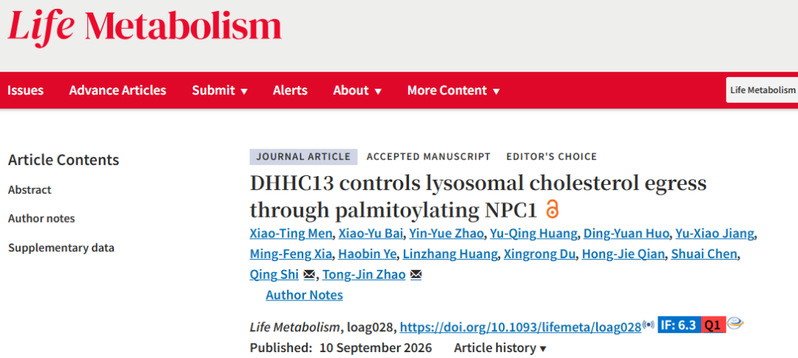
Protein S-palmitoylation provides a key regulatory mechanism for diverse cellular activities. Although palmitoylated proteins are frequently observed in cholesterol-enriched membrane microdomains, how protein palmitoylation reciprocally regulates cholesterol metabolism remains elusive. Here, we identify DHHC13 as a critical regulator linking protein palmitoylation to lysosomal cholesterol egress. Through an shRNA screen, we found that lack of DHHC13 led to pronounced lysosomal cholesterol accumulation. Mechanistically, DHHC13 directly palmitoylated Niemann-Pick C1 (NPC1). Loss of palmitoylation disrupted NPC1 association with lysosomes and causes its degradation, thereby impairing lysosomal cholesterol egress. Dhhc13−/− mice phenocopied Npc1−/− mice, displaying cholesterol deposition in the brain, liver, spleen, and kidney, along with significant Purkinje cell loss. Furthermore, two clinical DHHC13 mutants (Q173H and R451Q) associated with neurodegenerative disorders showed diminished catalytic activity and failed to restore NPC1 palmitoylation or lysosomal cholesterol egress. Collectively, our findings uncover DHHC13 as a critical regulator of lysosomal cholesterol metabolism via NPC1 palmitoylation, providing mechanistic insights into cholesterol-related neurological disorders.
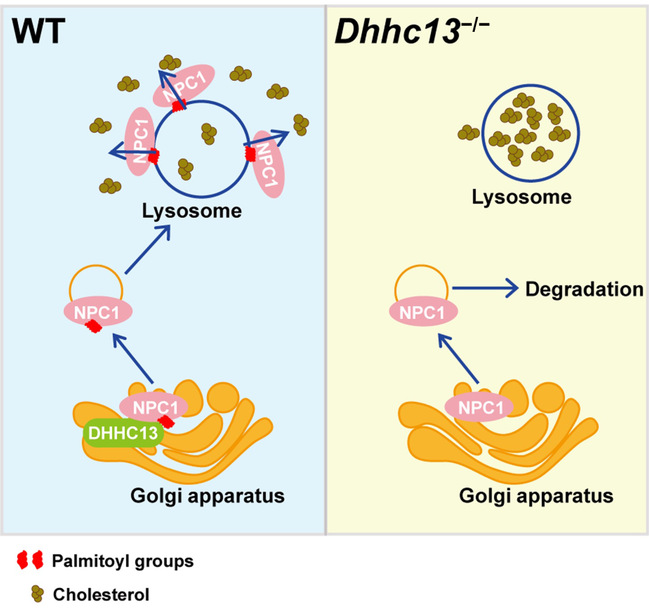
Fig. A working model of DHHC13-mediated regulation of lysosomal cholesterol egress.
Link: https://doi.org/10.1093/lifemeta/loag028
复旦大学 代谢与整合生物学研究院 版权所有
Copyright@2018fudan.edu.cn All rights reserved.
上海市杨浦区淞沪路2005号。邮编:200438。电话:021-31242078,021-31242079
 Fudan Email
 Fudan Ehall