News



Recently, the research groups led by Professor Tongjin Zhao and Professor Peng Li published a study entitled “DHHC12 serves as a critical nutrient-responsive switch that couples amino acid sensing to insulin secretion” in Nature Communications.
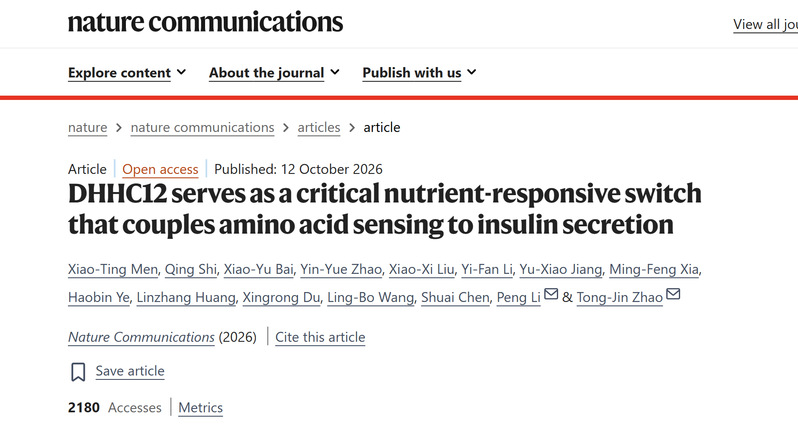
Protein palmitoylation covalently attaches the energy metabolite palmitate to target proteins, yet how it is regulated by nutrient status remains elusive. Here, we identify the palmitoyltransferase DHHC12 as a critical nutrient-responsive switch, coupling amino acid availability to insulin secretion. Amino acid deficiency activates the kinase GCN2, which phosphorylates COPA at Thr777, enabling its function as an adaptor for the CRL4 E3 ligase complex and leading to ubiquitination of DHHC12 on two critical cysteine residues (Cys127 and Cys133, with Cys127 within the catalytic DHHC motif) and its subsequent degradation. In male mice, loss of Dhhc12 impairs insulin secretion and causes glucose intolerance. DHHC12 palmitoylates SYT7 to promote glucose-stimulated insulin exocytosis. The physiological relevance of this pathway is underscored by two human DHHC12 variants: the hypoglycemia-associated L196P mutant evades degradation, whereas the hyperglycemia-linked N238I mutant is constitutively degraded. Together, our findings establish the GCN2-COPA-DHHC12 axis as a direct nutrient-sensing mechanism that couples amino acid availability to systemic glucose homeostasis.
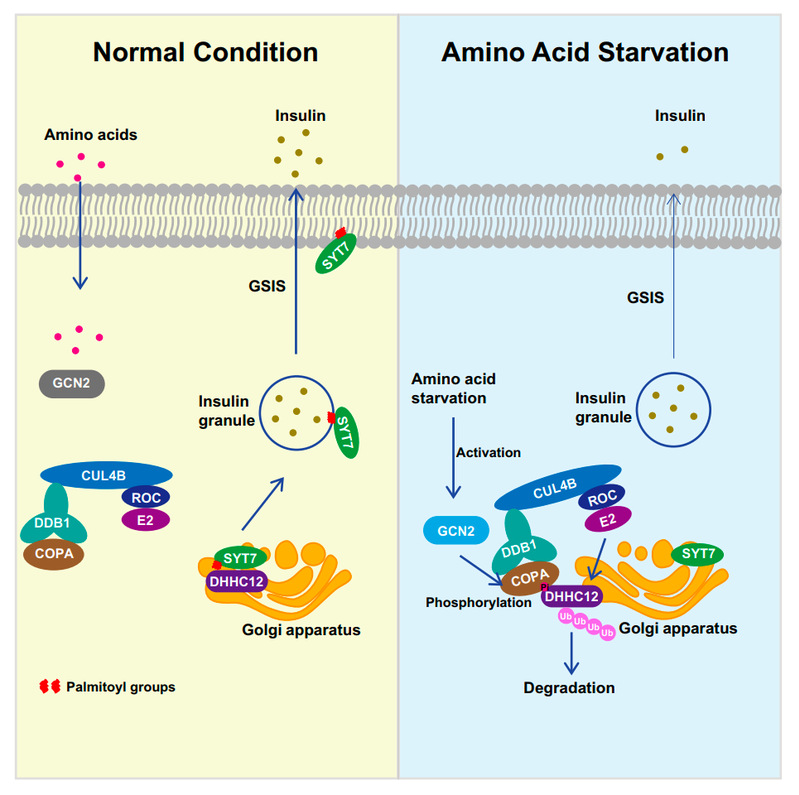
Fig. A Working model for the GCN2-COPA-DHHC12-SYT7 axis in linking amino acid availability to GSIS. Under amino acid replete conditions, DHHC12 palmitoylates SYT7 and targets it to insulin-secretory granules, priming the system for GSIS. Upon amino acid deprivation, GCN2 is activated and phosphorylates COPA at Thr777. This modification promotes recruitment of DHHC12 to the CRL4-COPA E3 ligase complex, leading to ubiquitination of DHHC12 at Cys127 and Cys133 and the subsequent degradation. Loss of DHHC12 impairs SYT7 palmitoylation and thus suppresses GSIS.
Link: https://doi.org/10.1038/s41467-026-78642-2
复旦大学 代谢与整合生物学研究院 版权所有
Copyright@2018fudan.edu.cn All rights reserved.
上海市杨浦区淞沪路2005号。邮编:200438。电话:021-31242078,021-31242079
 Fudan Email
 Fudan Ehall