News



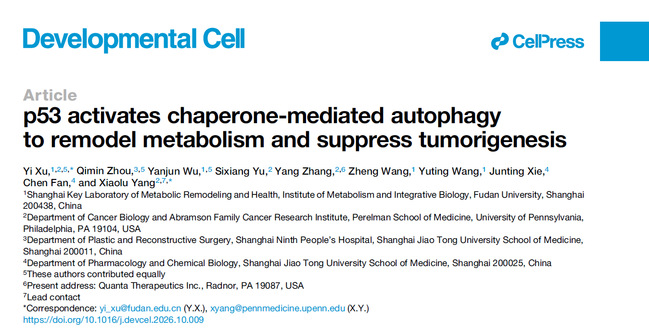
Recently, the research group led by Associate Professor Xu Yi from the Institute of Metabolism & Integrative Biology, Fudan University, in collaboration with the team of Xiaolu Yang at the University of Pennsylvania, published a research article in Developmental Cell entitled “p53 activates chaperone-mediated autophagy to remodel metabolism and suppress tumorigenesis”.
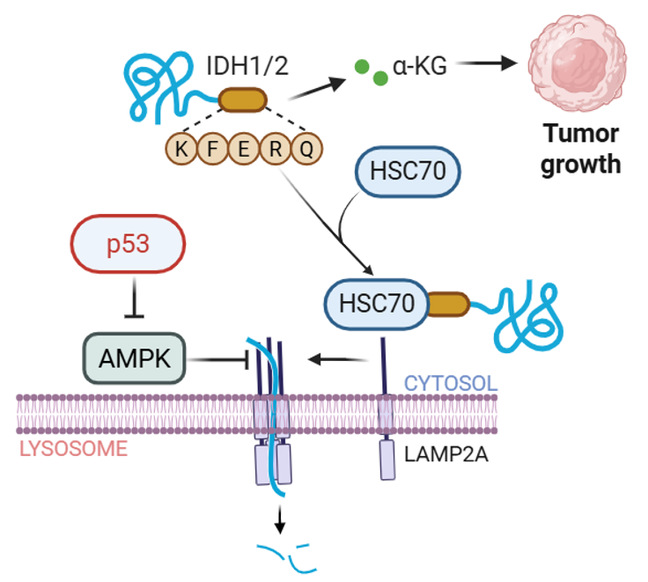
p53 protects against the initiation and progression of cancers, but the mechanisms underlying this function remain incompletely understood. Chaperone-mediated autophagy (CMA) is a form of autophagy unique in vertebrates, yet its regulation and function are unclear. Here, we demonstrate that p53 functions as a central activator of CMA, integrating stress signals to regulate this selective autophagic pathway. Mechanistically, the energy sensor AMP-activated protein kinase (AMPK) inhibits CMA by preventing oligomerization of its receptor LAMP2A. Cytoplasmic p53 interacts with AMPK and relieves this inhibition. By activating CMA, p53 promotes lysosomal degradation of isocitrate dehydrogenases IDH1 and IDH2, thereby reducing intracellular α-ketoglutarate levels, inhibiting reductive glutamine metabolism, and suppressing growth of lung and liver cancers. Tumor-associated p53 mutants fail to promote CMA, whereas oncogenic IDH1/2 mutants evade CMA-mediated degradation. These results suggest that CMA activation may be a fundamental component of p53 function, through which it modulates metabolism and inhibits oncogenic growth.
Link: https://doi.org/10.1016/j.devcel.2026.10.009
复旦大学 代谢与整合生物学研究院 版权所有
Copyright@2018fudan.edu.cn All rights reserved.
上海市杨浦区淞沪路2005号。邮编:200438。电话:021-31242078,021-31242079
 Fudan Email
 Fudan Ehall