News



In April 2026, the research group led by Associate Professor Wei Dai at the Institute of Metabolism and Integrative Biology (IMIB), Fudan University published a study entitled “Increased Yolk Lipid Mobilization Promotes Zebrafish Post‑Segmentation Growth via an Hnf4‑Lipoprotein Axis” in Cell Reports, which systematically compared the mobilization patterns of the two major yolk nutrients—proteins and lipids—in zebrafish.
Embryogenesis demands an increasing nutrient supply, yet how maternal reserves are temporally delivered remains unclear. In egg-laying vertebrates, reserves are pre-deposited in the yolk, providing a closed system to dissect this problem. Using zebrafish, we quantified mobilization of the two major yolk stores-protein and lipid-across embryogenesis. Protein catabolism is continuous from cleavage to hatching, whereas bulk lipid release is increased during embryogenesis. This increase is coupled to zygotic activation of hnf4a/b, which promotes a yolk-syncytial lipoprotein assembly/transport. The acidic lipases Pla2g15 and Lipf contribute to yolk-granule lipid hydrolysis, while Mttp-dependent lipoprotein export mediates delivery of yolk-derived lipids to the embryo through the circulation. Inhibiting this lipid-delivery pathway has minimal early effect but impairs post-segmentation growth. Comparative transcriptomic analyses further reveal a similar Hnf4-lipoprotein expression program in the mammalian yolk sac. Together, these findings define a stage-tuned, transcriptionally gated strategy for maternal nutrient utilization during early development.
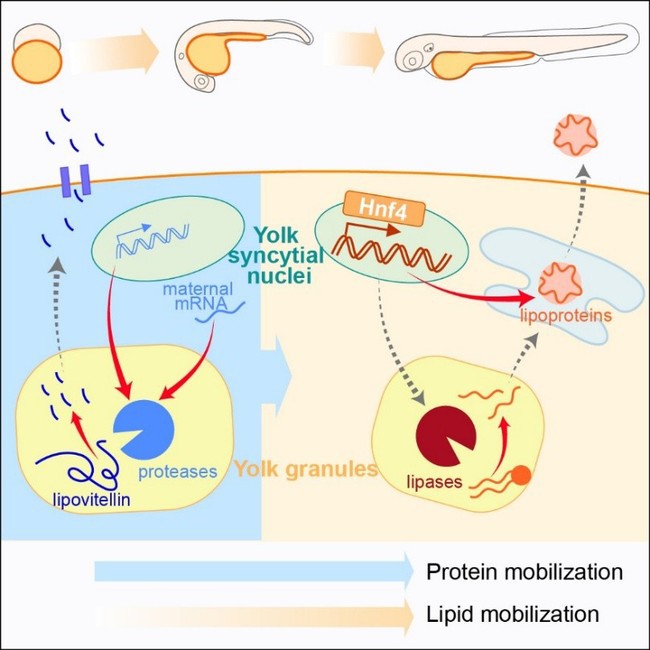
Figure: Patterns of yolk protein and lipid mobilization during zebrafish embryonic development
Link:https://doi.org/10.1016/j.celrep.2026.117295
复旦大学 代谢与整合生物学研究院 版权所有
Copyright@2018fudan.edu.cn All rights reserved.
上海市杨浦区淞沪路2005号。邮编:200438。电话:021-31242078,021-31242079
 Fudan Email
 Fudan Ehall