News



On April 1, 2026, the research results jointly completed by Professor Hongyan Wang from Institute of Metabolism and Integrative Biology of Fudan University, Researcher Xiangyu Zhou from Obstetrics & Gynecology Hospital of Fudan University and Director Zhiqiang Yu from Eye & ENT Hospital of Fudan University was published in Cell Research entitled “Increased PRSS56 expression is a causal factor and therapeutic target for human axial high myopia”.
High myopia (HM), characterized by significant ocular axial length elongation, affects hundreds of millions of people and is often inherited, particularly in cases that develop during childhood or adolescence. Although numerous myopia loci (MYP) have been identified, most causative genes remain undefined. Here, we analyzed two large HM pedigrees and refined the critical region through haplotype linkage analysis to a 3.9-Mb interval on 2q37.1, which was previously reported as MYP12 with an unknown pathogenic gene. Whole-genome sequencing identified the noncoding promoter variants c.-187G>T and c.-187G>C in PRSS56, encoding a trypsin-like serine protease, which exclusively co-segregated with all affected members in both pedigrees. Compared with matched controls, increased PRSS56 expression was observed in both patient-derived iPSCs carrying c.-187G>T and knock-in mice (c.-155G>T, corresponding to human c.-187G>T) that faithfully recapitulate myopia phenotypes. Noncoding PRSS56 variants promote self-expression via enhanced binding to the transcription factor EGR1, as confirmed by dual-luciferase assays. Notably, we demonstrated that higher PRSS56 levels directly increase ocular axial length in a dose- and activity-dependent manner in multiple transgenic mouse models. Guinea pig myopia models consistently exhibited high Prss56 expression, and short-wave light exposure reduced Prss56 mRNA levels and attenuated further axial elongation. Mechanistically, higher PRSS56 expression was associated with reduced abundance of myosin-4 in the sclera and with molecular signatures of scleral remodeling, which were in turn correlated with axial elongation. In conclusion, our findings provide strong genetic and functional evidence for the pathogenic role of noncoding PRSS56 variants in HM and highlight PRSS56 as a promising therapeutic target for juvenile HM.
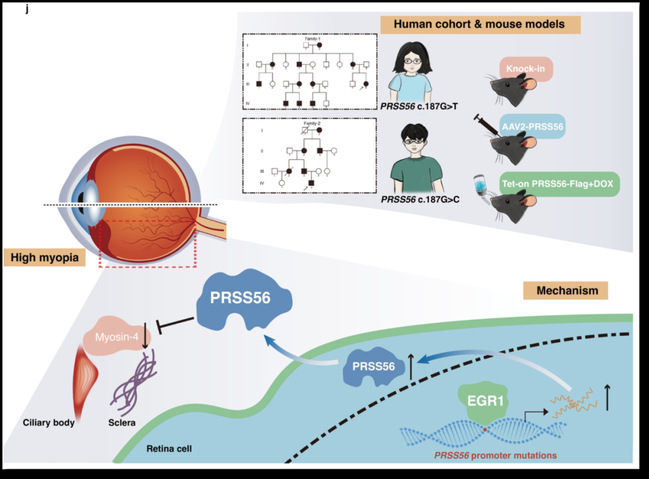
Figure: Systematic analysis of pathogenesis caused by PRSS56 non-coding mutations
Link: https://www.nature.com/articles/s41422-026-01241-9

复旦大学 代谢与整合生物学研究院 版权所有
Copyright@2018fudan.edu.cn All rights reserved.
上海市杨浦区淞沪路2005号。邮编:200438。电话:021-31242078,021-31242079
 Fudan Email
 Fudan Ehall