News



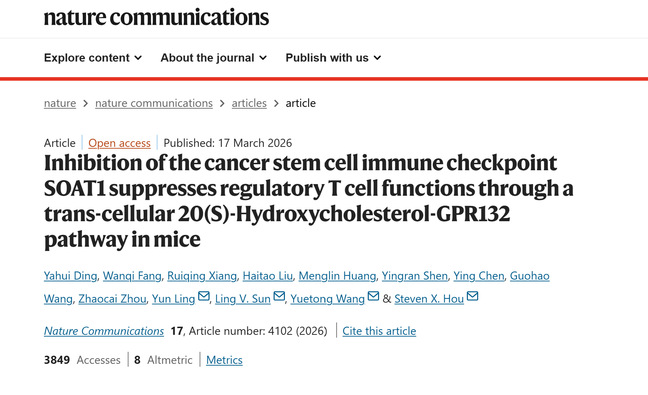
On March 17, 2026, the team led by Professor Xianyu Hou from the Institute of Metabolism and Integrative Biology (IMIB), Fudan University, published a research article entitled “Inhibition of the cancer stem cell immune checkpoint SOAT1 suppresses regulatory T cell functions through a trans-cellular 20(S)-Hydroxycholesterol-GPR132 pathway in mice” in Nature Communications.
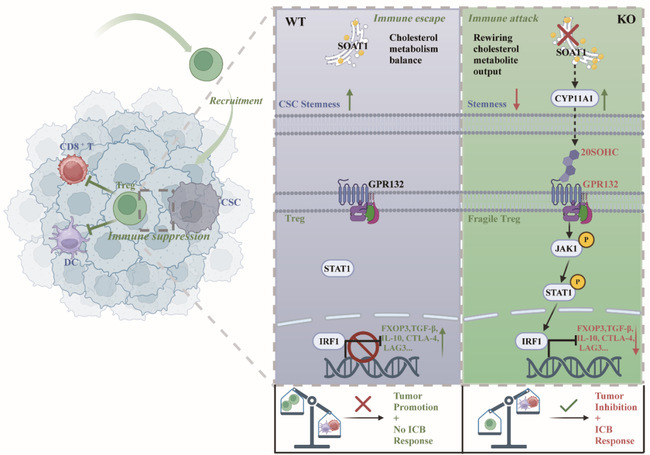
Although cancer immunotherapy has recently revolutionized treatment, the low response rate to existing immune checkpoint blockade (ICB) underscores the need for new druggable targets. Here, we find that SOAT1 is selectively expressed in cancer stem cell (CSC) and pharmacological inhibition with STK results in robust anti-tumor effects across various preclinical mouse models, including colon, liver, lung, breast, and melanoma cancer, with low toxicity. Mechanistically, treatment with STK (or gene knockdown of Soat1) induces the release of 20(S)-Hydroxycholesterol (20SOHC) from the tumor cells, and downstream activation of the trans-cellular 20SOHC (tumor)- GPR132 pathway in regulatory T cell (Treg), ultimately resulting in the suppression of Treg functions and enhanced dendritic cells and cytotoxic CD8+ T cell responses. Importantly, STK treatment synergizes with anti-PD-1 or anti-CTLA-4 ICB therapy. Thus, our findings identify SOAT1 as a CSC metabolism checkpoint that facilitates immune evasion and SOAT1 inhibition as a promising strategy for advanced cancer immunotherapy.
Link: https://www.nature.com/articles/s41467-026-69305-3
复旦大学 代谢与整合生物学研究院 版权所有
Copyright@2018fudan.edu.cn All rights reserved.
上海市杨浦区淞沪路2005号。邮编:200438。电话:021-31242078,021-31242079
 Fudan Email
 Fudan Ehall