News



In March 2026, the research group led by Young Investigator Paul Li-hao Huang from the Institute of Metabolism and Integrative Biology Fudan University, together with his collaborators, published a research article entitled "Psoriasis modulates inflammatory bowel disease risk and intestinal epithelium lipid metabolism via IL-1β-producing macrophages" in Cell Metabolism.
Patients with psoriasis have an increased risk of developing inflammatory bowel disease, yet the mechanisms underlying this comorbidity remain unclear. In a clinical cohort, we observed an inverse correlation between psoriasis severity and postprandial plasma apolipoprotein B48 levels, a finding recapitulated in experimental psoriasis mouse models, indicating impaired intestinal lipid handling. To directly interrogate this process, we developed a recombinant photoconvertible apolipoprotein B reporter that enables real-time quantification of endogenous chylomicron production in intestinal organoids and in vivo. Using this system, we demonstrate that psoriasis promotes the expansion of interleukin (IL)-1β-producing intestinal macrophages, which accelerate apolipoprotein B degradation, impair chylomicron secretion, drive epithelial lipid accumulation, and exacerbate mucosal inflammation. Integrating human and experimental data, our findings implicate macrophage-driven metabolic dysregulation of the intestinal epithelium as a mechanistic link between psoriasis and gut inflammation and highlight intestinal IL-1β as a potential therapeutic target.
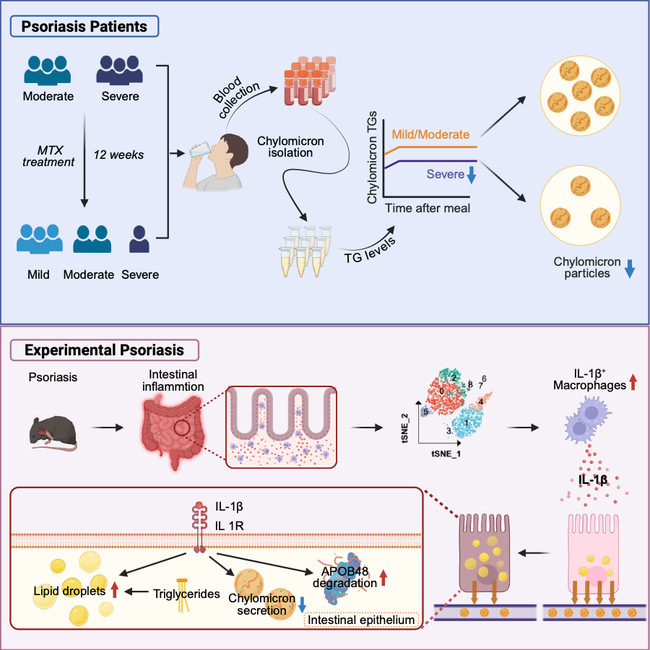
Figure: Schematic diagram of the study
Link:https://www.cell.com/cell-metabolism/fulltext/S1550-4131(26)00057-4
复旦大学 代谢与整合生物学研究院 版权所有
Copyright@2018fudan.edu.cn All rights reserved.
上海市杨浦区淞沪路2005号。邮编:200438。电话:021-31242078,021-31242079
 Fudan Email
 Fudan Ehall