News



On February 25, 2026, the team led by Professor Steven X Hou from the Institute of Metabolism and Integrative Biology (IMIB) Fudan University, together with his collaborators, published a research article entitled “PML targets and resolves structured protein inclusions to mitigate neurodegeneration” in Nature Cell Biology.
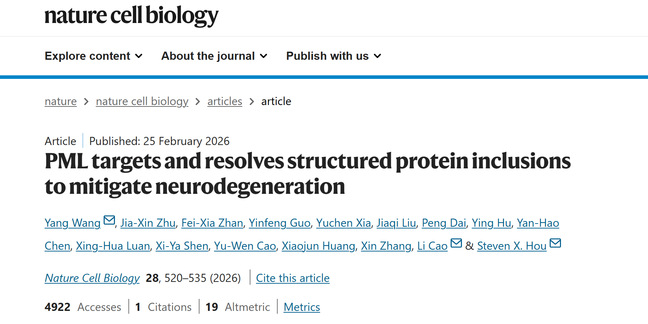
Intranuclear inclusions are defining features of many neurodegenerative diseases, yet their assembly mechanisms and pathological roles remain poorly understood. Here, we investigate polyglycine (polyG) inclusions in neuronal intranuclear inclusion disease (NIID) and show that they recruit intrinsically disordered proteins to form stratified, immobile condensates that disrupt nuclear protein quality control and DNA damage repair. Leveraging their ordered and stepwise assembly, we identify promyelocytic leukaemia protein (PML) as a key factor that actively recognizes and eliminates polyG inclusions through chaperone-mediated disaggregation and proteasome-dependent degradation. Engineered PML variants selectively clear both nuclear and cytoplasmic aggregates, including polyG, polyGA, polyQ, TDP-43 and SOD1. Systemic PML delivery alleviates cognitive and motor deficits in mouse models of NIID and TDP-43 proteinopathy. These findings uncover a conserved spatial organization of nuclear inclusions and establish PML as a therapeutic effector for neurodegenerative diseases linked to protein aggregation.
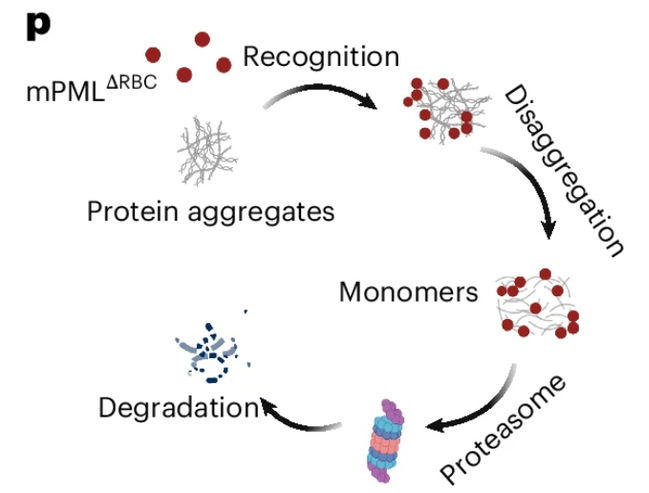
Schematic Mechanism (Image source: Nature Cell Biology)
Link: https://www.nature.com/articles/s41556-026-01894-z
复旦大学 代谢与整合生物学研究院 版权所有
Copyright@2018fudan.edu.cn All rights reserved.
上海市杨浦区淞沪路2005号。邮编:200438。电话:021-31242078,021-31242079
 Fudan Email
 Fudan Ehall