News



On November 25,2025, the research group led by Associate Professor Haobin Ye from the Institute of Metabolism and Integrative Biology (IMIB), Fudan University published a study entitled “A generalized strategy to kill leukemic cells by targeting the regulatory systems governing mitochondrial membrane potential” in Cell Reports.
Targeting mitochondria emerges as a promising anti-leukemia strategy, yet selective mitochondrial disruption remains challenging. Here, we identified elevated mitochondrial membrane potential (MMP) as a hallmark of leukemic transformation and chemotherapy-resistant cells, prompting screening for MMP-targeting agents. Alexidine (AD), an MMP-depleting compound, demonstrated potent anti-leukemic activity with low toxicity. Mechanistically, AD binds unsaturated cardiolipin to destabilize the inner membrane localization of mitochondrial ribosome, suppressing cardiolipin-dependent mitochondrial translation, a process validated as an independent prognostic marker in leukemia. Interestingly, intercellular heterogeneity in mitochondrial translation drives heterogeneous MMP states within the population, which is associated with stemness and chemoresistance. Intriguingly, this intra-population MMP difference stems not from cardiolipin-mediated translation but from asparagine-driven mitochondrial protein synthesis—a mechanism leukemia cells selectively activate to evade chemotherapy. Critically, pharmacological asparagine depletion synergistically enhances chemosensitivity by disrupting this resistance pathway. Our findings establish that MMP regulation through cardiolipin-maintained homeostasis and asparagine-fueled adaptation represents therapeutic vulnerabilities, advocating co-targeting strategies to overcome resistance.
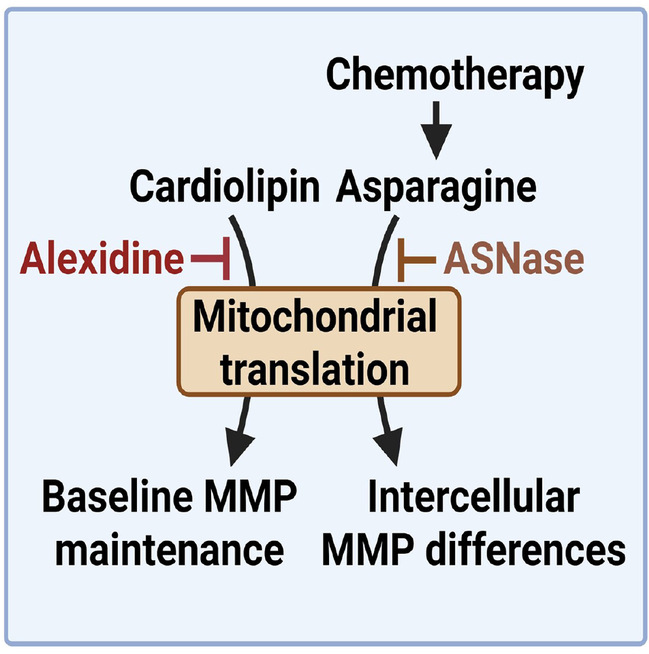
Figure: Working model
Link: https://doi.org/10.1016/j.celrep.2025.116496
复旦大学 代谢与整合生物学研究院 版权所有
Copyright@2018fudan.edu.cn All rights reserved.
上海市杨浦区淞沪路2005号。邮编:200438。电话:021-31242078,021-31242079
 Fudan Email
 Fudan Ehall