News


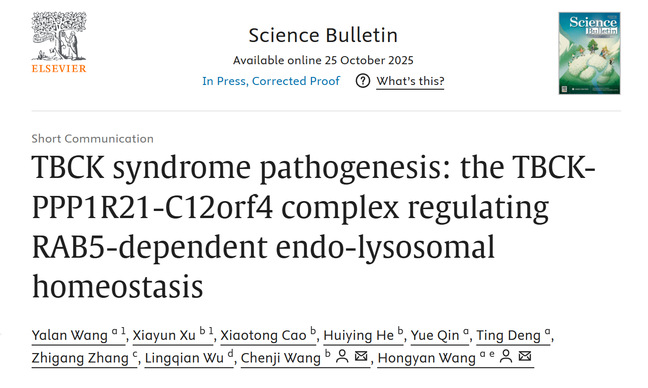
On November 8, 2025, the research group led by Professor Hongyan Wang from the Institute of Metabolism and Integrative Biology (IMIB), Fudan University and her collaborators published a research article entitled “TBCK syndrome pathogenesis: the TBCK-PPP1R21-C12orf4 complex regulating RAB5-dependent endo-lysosomal homeostasis” in Science Bulletin.
The study identifies a complex formed by TBCK, PPP1R21, and C12orf4—three proteins encoded by genes implicated in neurodevelopmental disorders—that acts as a putative RAB5 GAP. Disruption of this complex leads to RAB5 hyperactivation and consequent defects in endocytosis, lysosomal degradation, and autophagy, ultimately disturbing endo-lysosomal homeostasis in both human cells and mice. Global Tbck or Ppp1r21 KO causes perinatal lethality, limiting the use of these mouse models to evaluate the neurodegenerative phenotypes. This limitation further underscores the need for conditional knockout or knock-in strategies in future studies to dissect the disease mechanisms in vivo.
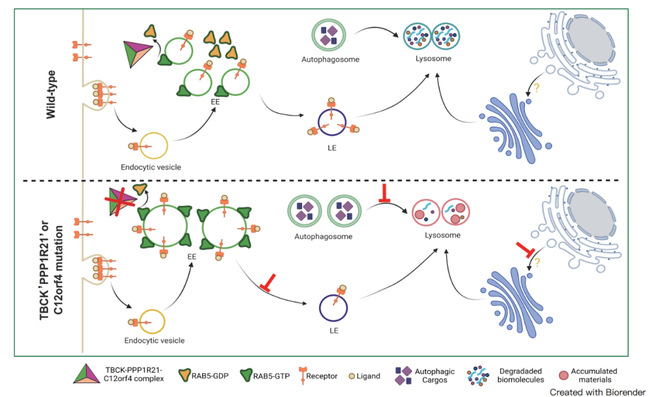
Figure: Disruption of the TBCK-PPP1R21-C12orf4 complex leads to excessive RAB5 activation and impaired endosome‑lysosome homeostasis.
Link: https://www.sciencedirect.com/science/article/pii/S2095927325010576
复旦大学 代谢与整合生物学研究院 版权所有
Copyright@2018fudan.edu.cn All rights reserved.
上海市杨浦区淞沪路2005号。邮编:200438。电话:021-31242078,021-31242079
 Fudan Email
 Fudan Ehall