News



On August 22, 2025, the research group led by Associate Professor Fuming Li from the Institute of Metabolism and Integrative Biology (IMIB), Fudan University published a research article entitled “α-Ketoglutarate dictates AMPK protein synthesis for energy sensing in human cancers” in Nature Chemical Biology.
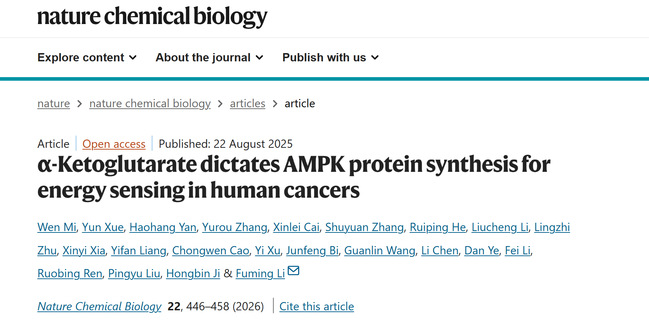
The energy sensor AMP-activated protein kinase (AMPK) promotes tumor cell survival under stress but how to prevent AMPK activation to blunt tumor progression remains unclear. Here we show that the metabolite α-ketoglutarate (α-KG) dictates AMPK translation through a TET–YBX1 axis, which can be exploited to sensitize human cancer cells to energy stress. α-KG-deficient cells fail to activate AMPK under glucose starvation, which elicits cytosolic NADPH depletion and disulfidptosis. Mechanistically, α-KG insufficiency inhibits TET-dependent transcription of YBX1, an RNA-binding protein required for human-specific AMPK protein synthesis. Similarly, α-KG competitors including succinate and itaconate inhibit the YBX1–AMPK axis and sensitize cancer cells to glucose deprivation. Lastly, cotargeting oncogenic YBX1 and GLUT1 creates synthetic lethality and blunts tumor growth in vivo. Together, our findings link α-KG to energy sensing through AMPK translation and propose that targeting α-KG–YBX1-dependent AMPK translation can sensitize human cancer cells to energy stress for treatment.
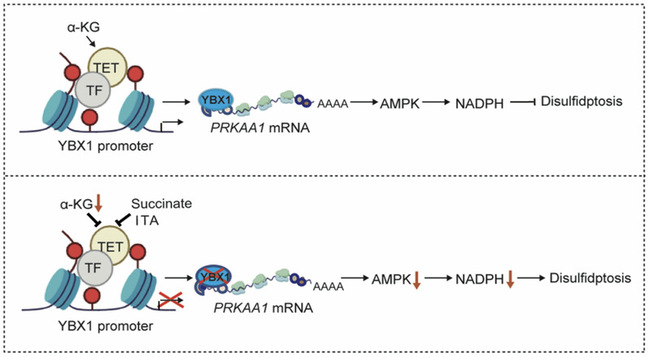
Figure: Working model of α-ketoglutarate in regulating AMPK protein synthesis and energy sensing
复旦大学 代谢与整合生物学研究院 版权所有
Copyright@2018fudan.edu.cn All rights reserved.
上海市杨浦区淞沪路2005号。邮编:200438。电话:021-31242078,021-31242079
 Fudan Email
 Fudan Ehall