News



On July 3, 2025, Dr.Feng-Jung Chen from the Institute of Metabolism and Integrative Biology (IMIB), Fudan University and his collaborators published a research article entitled “PI(4)P recruits CIDE proteins to promote the formation of unilocular lipid droplets during adipogenesis and hepatic steatosis” in PNAS.
Lipid droplets (LDs) are evolutionarily conserved organelles that play important roles in metabolism. Each LD is enclosed by a monolayer of phospholipids, distinct from bilayer membranes. The composition of LD surface phospholipids and their impact on LD growth and function remain to be defined. Phosphoinositides mark cellular organelles and regulate organellar function. Here, we demonstrate that PI(4)P decorates a subset of LDs to recruit and activate CIDE proteins. Enhanced expression of ORP2 and ORP5, LD-associated lipid transfer proteins that remove PI(4)P from LDs, abolished the localization and function of CIDE proteins. Blocking the synthesis of PI(4)P on the LD surface via knocking down PI4K2A also impaired the localization and function of CIDE proteins. In adipocytes, depleting PI(4)P dramatically reduced the size of LDs, as well as adipose tissue mass. In severe steatotic liver, depleting PI(4)P impeded LD enlargement. Our results thus identify a key function of LD surface PI(4)P under physiological conditions and unveil how CIDE proteins are recruited to LDs.
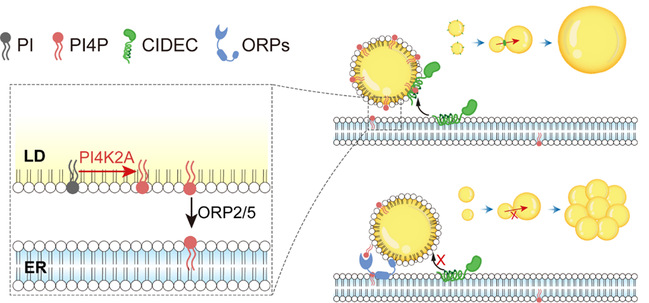
Figure: Working model for the regulatory mechanism by which PI(4)P recruits CIDE proteins on lipid droplets and lipid droplet fusion
Link: https://www.pnas.org/doi/10.1073/pnas.2504219122
复旦大学 代谢与整合生物学研究院 版权所有
Copyright@2018fudan.edu.cn All rights reserved.
上海市杨浦区淞沪路2005号。邮编:200438。电话:021-31242078,021-31242079
 Fudan Email
 Fudan Ehall