News


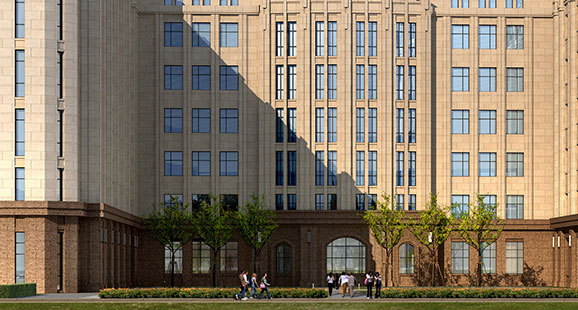
On June 3, 2026, the research group led by Associate Professor Fuming Li from the Institute of Metabolism and Integrative Biology (IMIB), Fudan University, together with the groups led by Associate Professor Pingyu Liu from the Human Phenome Institute, Fudan University and Associate Professor Xinyuan Tong from Shanghai Chest Hospital, published a research article entitled "LKB1 inactivation elicits an NNMT-mediated methyl sink and confers dependence on PRMT5 in lung cancer" in Cell Reports.
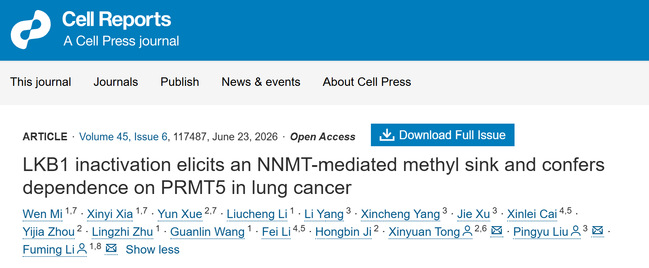
The protein arginine methyl transferase 5 (PRMT5) emerges as a therapeutic target in S-methyl-5′-thioadenosine phosphorylase (MTAP)-deleted cancers, where 5′-methylthioadenosine (MTA) accumulation partially inhibits its activity. However, it remains unclear whether other genetic alterations can dictate PRMT5 activity in cancer. Here, we identify liver kinase B1 (LKB1) as an alternative predictor of PRMT5 inhibition in lung cancer independent of MTAP. Mechanistically, LKB1 loss activates salt-inducible kinase 1/2 (SIK1/2)-cAMP response element-binding protein-regulated transcription coactivator 2 (CRTC2) signaling to upregulate nicotinamide N-methyltransferase (NNMT), creating a "methyl sink" that lowers the S-adenosylmethionine/S-adenosylhomocysteine (SAM/SAH) ratio and attenuates PRMT5 activity. NNMT overexpression is sufficient to induce this hypomorphic PRMT5 state and heighten sensitivity to PRMT5 inhibitors. Functionally, PRMT5 inhibition induces senescence in LKB1-deficient cells and confers vulnerability to navitoclax, synergistically blunting tumor growth in vivo. Collectively, we identify PRMT5 as an actionable therapeutic vulnerability in LKB1-deficient lung cancer, and propose LKB1 status/NNMT expression as potential biomarkers for PRMT5 inhibition. These findings may expand the clinical utility of PRMT5-targeted therapies beyond MTAP-deleted cancers.
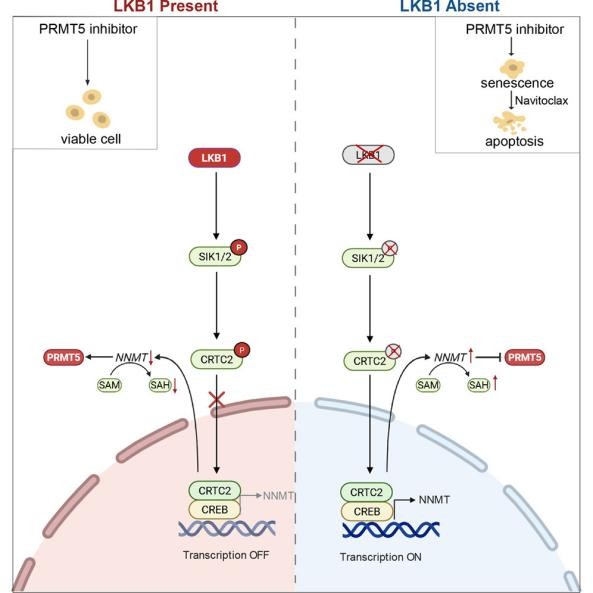
Figure 1: Working model of PRMT5 activity inhibition by LKB1 deficiency
Link: https://doi.org/10.1016/j.celrep.2026.117487
复旦大学 代谢与整合生物学研究院 版权所有
Copyright@2018fudan.edu.cn All rights reserved.
上海市杨浦区淞沪路2005号。邮编:200438。电话:021-31242078,021-31242079
 Fudan Email
 Fudan Ehall