News



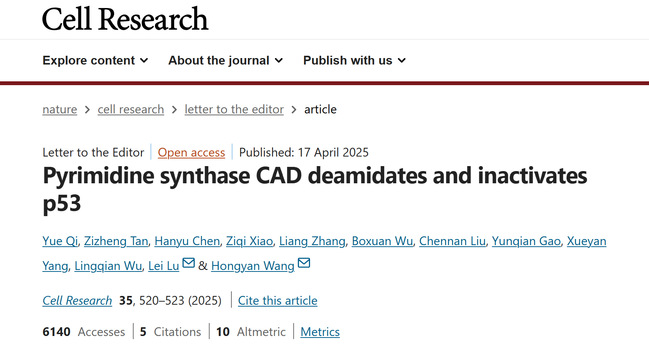
On April 17, 2025, the research group led by Professor Hongyan Wang from the Institute of Metabolism and Integrative Biology (IMIB), Fudan University published a research article entitled “Pyrimidine synthase CAD deamidates and inactivates p53” in Cell Research.
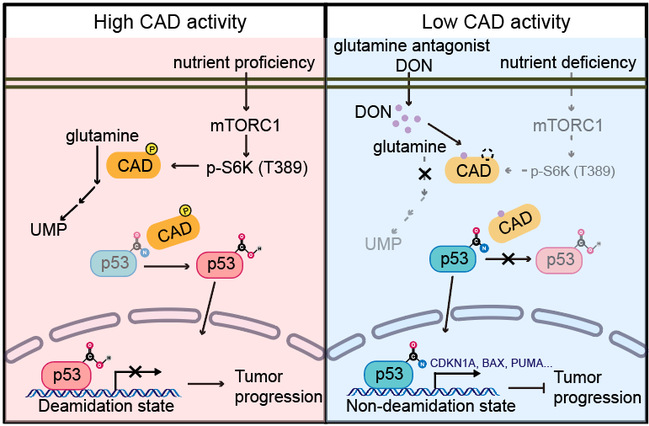
The findings highlight deamidation as a new PTM of p53, essential for inhibiting the activity of p53. It becomes more reasonable for researchers to understand what indicated by an increase of CAD copy number or expression level of CAD in tumors. However, nucleotide pool imbalance caused by CAD inhibition or DON treatment may further amplify p53 activation through DNA damage response. The study reveals that, beyond its role in pyrimidine biosynthesis, CAD deamidates and suppresses p53, thereby promoting tumor growth. High CAD expression in tumors may inactivate WT p53 through deamidation, contributing to tumor progression in a manner similar to p53 loss-of-function mutations. Thus, both high CAD expression and p53 mutations may represent evolutionary mechanisms that drive tumor development. The glutamine analog DON effectively inhibited CAD and restored p53 activity. Here researchers found that deamidation at N235/N239 significantly suppressed p53 transcriptional activity. Intriguingly, these residues reside within a global suppressor motif of p53, where other mutations (e.g., R/Y/K/W/F) have been shown to restore functionality in certain tumor-associated p53 mutants. This suggests that electrostatic modulation at N235 and N239 play a key role in regulating p53 function. Elucidating how these residues impact the global structure and function of the p53 protein deserves future investigation. The study suggests a potential strategy for stratifying patients for cancer therapy, indicating that those with WT p53 and high CAD expression may benefit from treatment with glutamine antagonists.
Link: https://doi.org/10.1038/s41422-025-01112-9

复旦大学 代谢与整合生物学研究院 版权所有
Copyright@2018fudan.edu.cn All rights reserved.
上海市杨浦区淞沪路2005号。邮编:200438。电话:021-31242078,021-31242079
 Fudan Email
 Fudan Ehall