News



On October 9, 2024, the research group of Professor Guanlin Wang from the Institute of Metabolism and Integrative Biology at Fudan University, in collaboration with the groups of Professor Bethan Psaila and Professor Adam Mead from the University of Oxford, published an online research paper in Science Translational Medicine, entitled “A proinflammatory stem cell niche drives myelofibrosis through a targetable galectin-1 axis”.
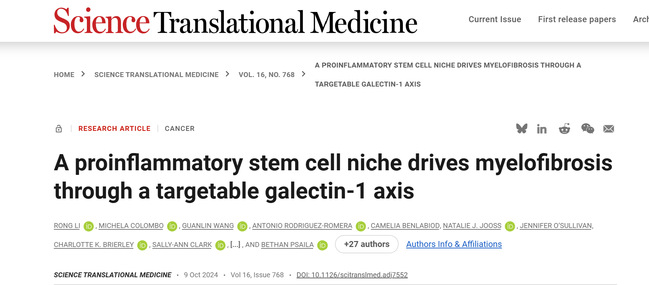
Myeloproliferative neoplasms are stem cell–driven cancers associated with a large burden of morbidity and mortality. Most patients present with early-stage disease, but a substantial proportion progress to myelofibrosis or secondary leukemia, advanced cancers with a poor prognosis and high symptom burden. Currently, it remains difficult to predict progression, and therapies that reliably prevent or reverse fibrosis are lacking. A major bottleneck to the discovery of disease-modifying therapies has been an incomplete understanding of the interplay between perturbed cellular and molecular states. Several cell types have individually been implicated, but a comprehensive analysis of myelofibrotic bone marrow is lacking. We therefore mapped the cross-talk between bone marrow cell types in myelofibrotic bone marrow. We found that inflammation and fibrosis are orchestrated by a “quartet” of immune and stromal cell lineages, with basophils and mast cells creating a TNF signaling hub, communicating with megakaryocytes, mesenchymal stromal cells, and proinflammatory fibroblasts. We identified the β-galactoside–binding protein galectin-1 as a biomarker of progression to myelofibrosis and poor survival in multiple patient cohorts and as a promising therapeutic target, with reduced myeloproliferation and fibrosis in vitro and in vivo and improved survival after galectin-1 inhibition. In human bone marrow organoids, TNF increased galectin-1 expression, suggesting a feedback loop wherein the proinflammatory myeloproliferative neoplasm clone creates a self-reinforcing niche, fueling progression to advanced disease. This study provides a resource for studying hematopoietic cell–niche interactions, with relevance for cancer-associated inflammation and disorders of tissue fibrosis.
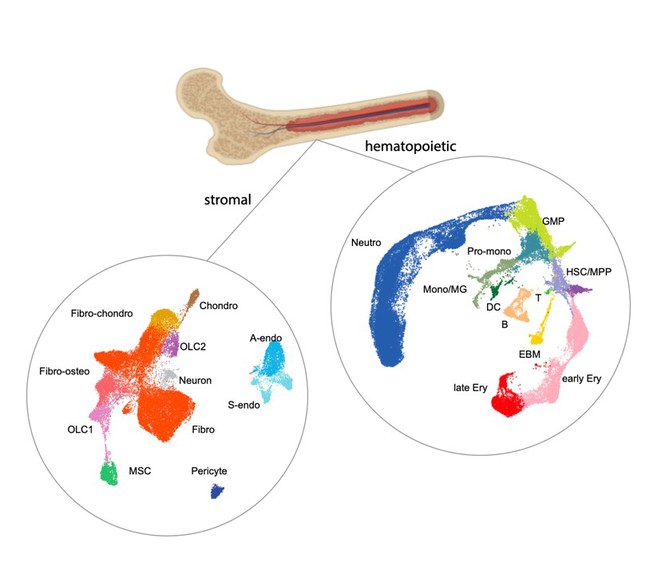
Figure 1: Single-cell atlas of myelofibrosis
复旦大学 代谢与整合生物学研究院 版权所有
Copyright@2018fudan.edu.cn All rights reserved.
上海市杨浦区淞沪路2005号。邮编:200438。电话:021-31242078,021-31242079
 Fudan Email
 Fudan Ehall