News


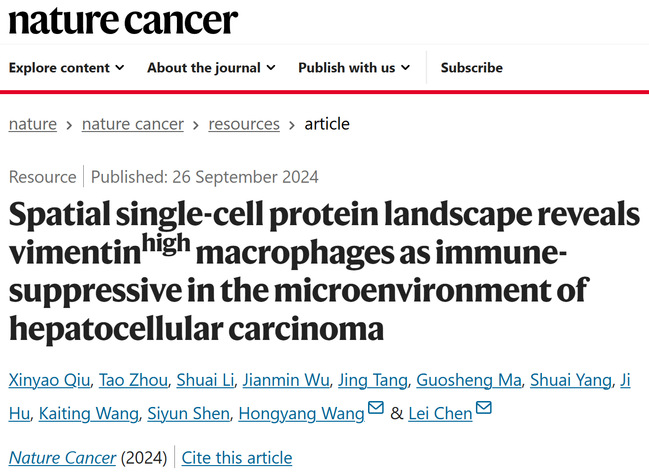
On September 26, 2024, Academician Hongyang Wang from the Institute of Metabolism and Integrative Biology at Fudan University, together with her collaborators, published an online research paper in Nature Cancer (IF=23.5) entitled “Spatial single-cell protein landscape reveals vimentinhigh macrophages as immune-suppressive in the microenvironment of hepatocellular carcinoma”.
Tumor microenvironment heterogeneity in hepatocellular carcinoma (HCC) on a spatial single-cell resolution is unclear. Here, we conducted co-detection by indexing to profile the spatial heterogeneity of 401 HCC samples with 36 biomarkers. By parsing the spatial tumor ecosystem of liver cancer, we identified spatial patterns with distinct prognosis and genomic and molecular features, and unveiled the progressive role of vimentin (VIM)high macrophages. Integration analysis with eight independent cohorts demonstrated that the spatial co-occurrence of VIMhigh macrophages and regulatory T cells promotes tumor progression and favors immunotherapy. Functional studies further demonstrated that VIMhigh macrophages enhance the immune-suppressive activity of regulatory T cells by mechanistically increasing the secretion of interleukin-1β. Our data provide deep insights into the heterogeneity of tumor microenvironment architecture and unveil the critical role of VIMhigh macrophages during HCC progression, which holds potential for personalized cancer prevention and drug discovery and reinforces the need to resolve spatial-informed features for cancer treatment.
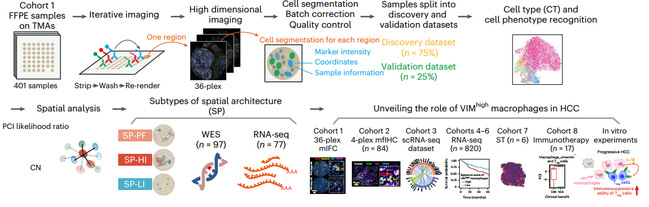
Mechanism schematic diagram (Reprinted from Nature Cancer)
复旦大学 代谢与整合生物学研究院 版权所有
Copyright@2018fudan.edu.cn All rights reserved.
上海市杨浦区淞沪路2005号。邮编:200438。电话:021-31242078,021-31242079
 Fudan Email
 Fudan Ehall