News



Recently, the research group led by Professor Hongyan Wang from the Institute of Metabolism and Integrative Biology at Fudan University, in collaboration with groups of Academician Jinsong Li from the Center for Excellence in Molecular Cell Science, Chinese Academy of Sciences and Associate Professor Yunping Lei from Baylor College of Medicine, published a research article entitle “The interaction of Endorepellin and Neurexin triggers neuroepithelial autophagy and maintains neural tube development” in Science Bulletin.
Heparan sulfateproteoglycan 2 (HSPG2) gene encodes the matrix proteinPerlecan, and genetic inactivation of this gene creates mice that are embryonic lethal with severe neural tube defects (NTDs). We discovered rare genetic variants of HSPG2 in 10% cases compared to only 4% in controls among a cohort of 369 NTDs. Endorepellin, a peptide cleaved from the domain V of Perlecan, is known to promote angiogenesis and autophagy in endothelial cells. The roles of enderepellin in neurodevelopment remain unclear so far. Our study revealed that endorepellin can migrate to the neuroepithelial cells and then be recognized and bind with the neuroepithelia receptor neurexinin vivo. Through the endocytic pathway, the interaction of endorepellin and neurexin physiologically triggers autophagy and appropriately modulates the differentiation of neural stem cells into neurons as a blocker, which is necessary for normal neural tube closure. We created knock-in (KI) mouse models with human-derived HSPG2 variants, using sperm-like stem cells that had been genetically edited by CRISPR/Cas9. We realized that any HSPG2 variants that affected the function of endorepellin were considered pathogenic causal variants for human NTDs given that the severe NTD phenotypes exhibited by these KI embryos occurred in a significantly higher response frequency compared to wildtype embryos. Our study provides a paradigm for effectively confirming pathogenic mutations in other genetic diseases. Furthermore, we demonstrated that using autophagy inhibitors at a cellular level can repress neuronal differentiation. Therefore, autophagy agonists may prevent NTDs resulting from failed autophagy maintenance and neuronal over-differentiation caused by deleterious endorepellin variants.
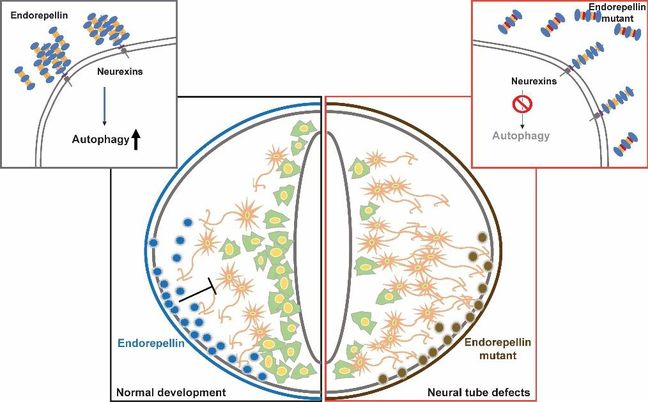
Figure 1: Endorepellin and Neurexin interact and trigger autophagy through endocytosis, inhibiting the differentiation of neural stem cells into neurons and maintaining normal neural tube closure; the Endorepellin mutant fails to effectively promote autophagy or suppress the excessive differentiation of neural stem cells, leading to the occurrence of NTDs.
Link: https://doi.org/10.1016/j.scib.2024.03.026
复旦大学 代谢与整合生物学研究院 版权所有
Copyright@2018fudan.edu.cn All rights reserved.
上海市杨浦区淞沪路2005号。邮编:200438。电话:021-31242078,021-31242079
 Fudan Email
 Fudan Ehall