News



On January 4, 2024, the research group of Young Investigator Ruobing Ren from the Institute of Metabolism and Integrative Biology at Fudan University, in collaboration with the groups of Assistant Professor Hongli Hu and Assistant Professor Yingzhi Jiang from the Kobilka Institute of Innovative Drug Discovery at The Chinese University of Hong Kong (Shenzhen), published a research paper entitled “Structural insights into the activation and inhibition of CXC chemokine receptor 3” in Nature Structural & Molecular Biology.
The chemotaxis of CD4+ type 1 helper cells and CD8+ cytotoxic lymphocytes, guided by interferon-inducible CXC chemokine 9-11 (CXCL9-11) and CXC chemokine receptor 3 (CXCR3), plays a critical role in type 1 immunity. Here we determined the structures of human CXCR3-DNGi complexes activated by chemokine CXCL11, peptidomimetic agonist PS372424 and biaryl-type agonist VUF11222, and the structure of inactive CXCR3 bound to noncompetitive antagonist SCH546738. Structural analysis revealed that PS372424 shares a similar orthosteric binding pocket to the N terminus of CXCL11, while VUF11222 buries deeper and activates the receptor in a distinct manner. We showed an allosteric binding site between TM5 and TM6, accommodating SCH546738 in the inactive CXCR3. SCH546738 may restrain the receptor at an inactive state by preventing the repacking of TM5 and TM6. By revealing the binding patterns and the pharmacological properties of the four modulators, we present the activation mechanisms of CXCR3 and provide insights for future drug development.
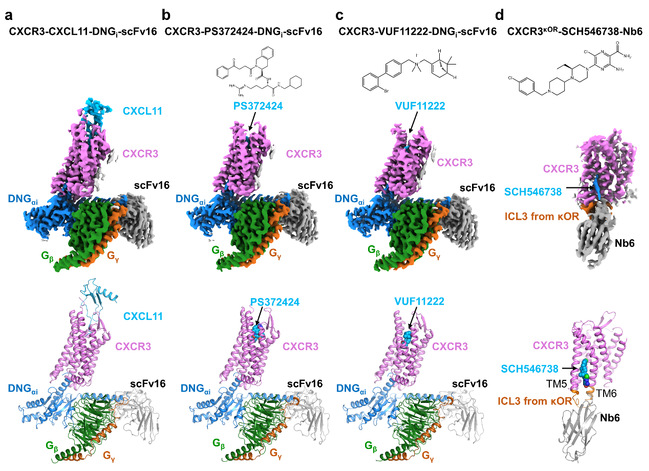
Fig. 1: Overall structures of the CXCR3-CXCL11-DNGi-scFv16, CXCR3-PS372424-DNGi-scFv16, CXCR3-VUF11222-DNGi-scFv16 and CXCR3κOR-SCH546738-Nb6 complex.
In addition, on November 28, 2023, the research groups of Young Investigator Ruobing Ren and Assistant Professor Hongli Hu jointly published a study entitled "Structure basis for the modulation of CXC chemokine receptor 3 by antagonist AMG487" in Cell Discovery.
复旦大学 代谢与整合生物学研究院 版权所有
Copyright@2018fudan.edu.cn All rights reserved.
上海市杨浦区淞沪路2005号。邮编:200438。电话:021-31242078,021-31242079
 Fudan Email
 Fudan Ehall