News



On December 20, 2023, the research groups led by Young Investigators Ruobing Ren, Li Chen and Wei Dai from the Institute of Metabolism and Integrative Biology, Fudan University collaborated to publish an online article entitled “Molecular basis of Spns2 facilitated sphingosine-1-phosphate transport” in Cell Research.
We reported two inward-open structures of human Spns2, bound with S1P and the inhibitor 16d, respectively. Using the cell-based efflux assay and the in vivo embryonic heart development assay in zebrafish, we validated the S1P binding site in our structure and identified critical residues for S1P transport through Spns2. The positively charged residues R227 and R119 are critical for S1P transport and may serve as the “holder” to facilitate the phosphoryl group of S1P to flip from the intracellular to the extracellular side. The disease related residue R200 may play a vital role in stabilizing the NTD conformation and the Ser substitution of R200 caused abnormal Spns2 translocation to the plasma membrane. The extensive and dynamic hydrogen-bond network among those charged residues may also stabilize the specific conformations during the S1P transport cycle. Notably, the D137-R342 pair may function as an inward-facing locker, but the R227-D445 pair may serve as an outward-facing locker. Thus, we proposed an alternating access cycle of S1P transport facilitated by Spns2. Besides, we also proposed FTY720-P transport by Spns2 using a similar mechanism as S1P. Altogether, our structural and functional studies of S1P transport shed light on the S1P transport mechanism by Spns2 and will promote the optimization or exploration of new chemical scaffolds of Spns2 inhibitors.
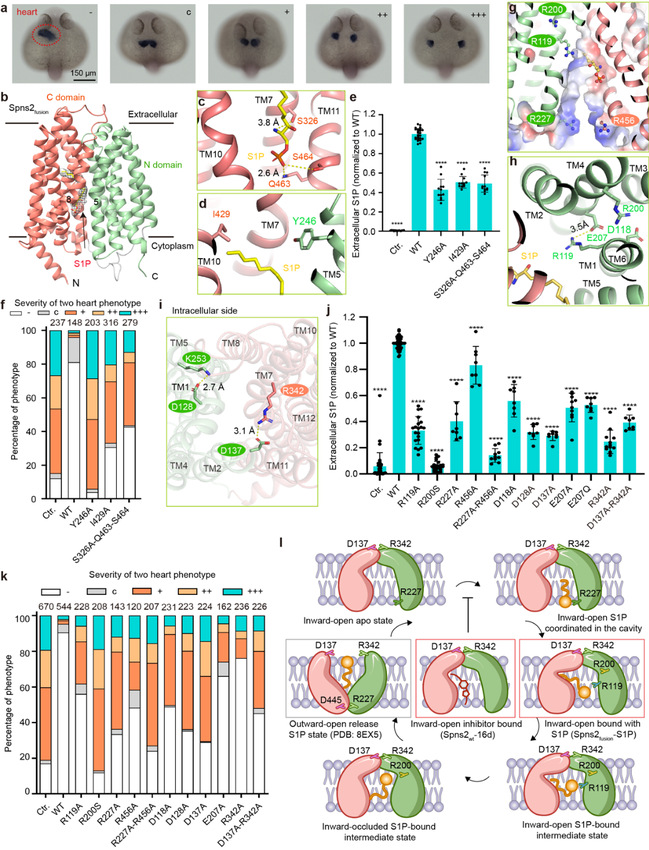
Fig. 1: Cryo-EM structure of S1P bound Spns2 and biochemical characterization of Spns2-mediated S1P transport.
Link: https://doi.org/10.1038/s41422-023-00908-x
复旦大学 代谢与整合生物学研究院 版权所有
Copyright@2018fudan.edu.cn All rights reserved.
上海市杨浦区淞沪路2005号。邮编:200438。电话:021-31242078,021-31242079
 Fudan Email
 Fudan Ehall